What Nutrition Brand Triathletes Should Choose For 70.3 and Ironman Triathlons

Why pro-endorsed nutrition isn’t the shortcut you think
It’s a familiar pattern in triathlon. A professional athlete shares a photo featuring a gel or drink mix, praises it as a game-changer, and suddenly that product is everywhere — on social feeds, at club sessions, and in transition bags.
The assumption is understandable: if it works for them, it must work for me.
In practice, this mindset often creates more problems than it solves.
Sports nutrition marketing is clever. Terms like “optimised carbohydrate ratios,” “rapid absorption,” and “elite-level performance” promise certainty on race day.
But certainty doesn’t come from copying what a professional uses.
It comes from understanding what your body needs, and then applying that consistently in training.
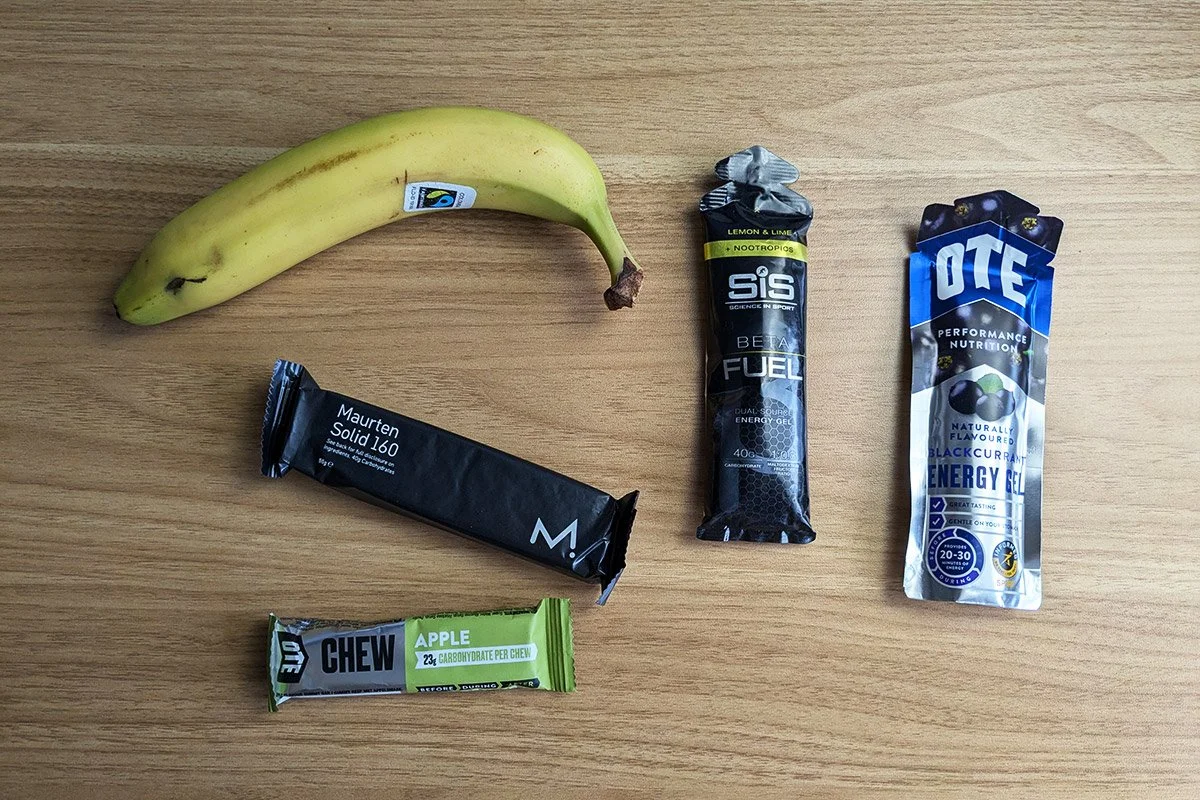
With brands like Science in Sport, Maurten, Precision Fuel and Hydration, to name but a few, all possibilities for 70.3 and Ironman triathlons, there's never been more options available.
Through my work as a registered sports nutritionist I've worked with hundreds of triathletes who have used different brands and products.
In this article we'll dig into what sports nutrition is best for triathletes, so you can make the right choice.
The reality of sports nutrition choices
Choosing race fuel can feel overwhelming.
Carbohydrate blends, gels versus drinks, neutral or sweet flavours, grams per serving — the options are endless.
Some of these details do matter. Others are far less important than they appear.
You may have seen claims around glucose-to-fructose ratios, such as 2:1 or 1:0.8.
Research has shown that combining these carbohydrate types can increase the amount of carbohydrate absorbed and used for energy, particularly at higher intakes.
Currently, 1:0.8 seems to be the “best”.
In theory, that extra efficiency could make a difference at the sharp end of racing.
However, for the vast majority of age-group triathletes, this is not where performance is won or lost.
Why the “perfect formula” often fails
The human body is remarkably pragmatic.
It doesn’t reward clever formulations if the fundamentals are missing.
A technically superior carbohydrate blend is irrelevant if:
You are consistently under-fuelling
You struggle with gastrointestinal (GI) symptoms
You dislike the taste or texture and avoid using it
A 1:0.8 glucose-to-fructose ratio offers no benefit if you are only consuming 40 grams of carbohydrate per hour when your event demands closer to 70 grams.
No formulation will rescue you once energy levels drop and fatigue inevitably takes over.
Chasing the “next best” product — switching gels, drinks, chews, or ratios — often disrupts consistency and makes fuelling less reliable, not more.
What actually predicts successful race nutrition
My work with triathletes across all distances and abilities reveals a clear pattern.
Performance is not dictated by brand choice.
It comes down to whether an athlete consumes the appropriate amount of carbohydrates for their event, uses products their gut can tolerate, and practices their fuelling strategy.
It’s not uncommon to see athletes attempt to replicate a professional’s nutrition strategy, only to discover that the products don’t suit them.
Persisting with something you dislike or cannot tolerate often leads to missed carbohydrate targets — and poorer performance as a result.
Athletes who race well treat nutrition as a trained skill. By race day, their fuelling plan feels routine rather than experimental.
To show what that looks like in practice, this video walks through a realistic 70.3 race nutrition plan — focusing on carbohydrate targets, product tolerance, and how to structure intake without overcomplicating it.
A practical hierarchy for triathlon race fuel
Rather than focusing on marketing claims, it helps to prioritise nutrition decisions in the order that actually matters.
1. Get your carbohydrate intake into the right range
For races lasting longer than around 2.5 hours, most triathletes benefit from at least 60 grams of carbohydrate per hour, and often more for long-course events.
Under-fuelling remains one of the most common — and most limiting — issues in endurance racing.
Until this is addressed, refinements elsewhere are largely irrelevant.
2. Use more than one carbohydrate type when needed
The body can absorb only a limited amount of glucose per hour.
Once intake rises above roughly 60 grams per hour, adding fructose allows for higher total carbohydrate absorption.
At this stage, the exact ratio is not critical.
The priority is simply including both sources so higher intakes and absorption is possible.
3. Train your gut, don’t avoid the problem
Carbohydrate tolerance is adaptable.
Experiencing GI discomfort does not automatically mean you need a different product — it often means the gut has not been progressively trained.
With gradual increases and consistent practice, many athletes comfortably move from lower intakes to 70 grams per hour or more without issue.
This process takes time, but it is far more effective than constantly changing products.
4. Only then worry about the fine details
Once you are fuelling adequately, tolerating it well, and practising consistently, you can consider whether a specific carbohydrate ratio offers marginal gains.
Both traditional 2:1 blends and newer 1:0.8 formulations can support excellent performances.
The difference between them is small compared to the impact of hitting the right intake and digesting it comfortably.
Consistency beats novelty
Nutrition, like training, rewards repetition.
The most effective strategy is rarely the most exciting one.
A fuel plan that feels “boring” but is reliable will outperform a cutting-edge product that disrupts your routine.
For most triathletes, success comes from:
Adequate carbohydrate intake
No GI symptoms
Confidence built through practice, not marketing promises
The bigger picture
Sports nutrition companies are skilled at highlighting common triathlon concerns — cramping, fatigue, late-race fade — and presenting products as solutions.
While nutrition does play a role, these issues are rarely fixed by a single ingredient or ratio.
Long-term performance is built on sound training, appropriate fuelling, and patience.
One important factor in your 70.3 race performance is ensuring a structured carbohydrate loading protocol. You can download my free carbohydrate loading guide that gives you examples you can follow that will let you race to your potential.